1General Disclosures
1.1Reporting Practices and Basis for Preparation
GRI 2-2: Entities included in the organization’s sustainability reporting
GRI 2-3: Reporting period, frequency and contact point
GRI 2-4: Restatements of information
GRI 2-5: External assurance
The Cicor Sustainability Report for the fiscal year 2025 (1 January 2025 to 31 December 2025) outlines non-financial information in compliance with Art. 964b of the Swiss Code of Obligations. Cicor has integrated essential aspects of the GRI Sustainability Reporting Standards and the Task Force on Climate-Related Disclosures (TCFD) into its reporting framework to ensure a unified approach towards transparent disclosure practices. Cicor publishes this report annually as part of its Annual Report. The Annual Report provides detailed information in various sections, including the Management Report, Sustainability Report, Corporate Governance Report, Remuneration Report, and Financial Report.
The previous report was published in March 2024 as a supplement to the Annual Report 2024. No restatements have been made for previously reported data. Unless specified otherwise, the statements and key figures in this report refer to the fiscal year 2025. To help readers identify and interpret trends relating to qualitative disclosures, this report includes data from at least the 2023, 2024, and 2025 fiscal years, where relevant. Unless stated otherwise, the Sustainability Report 2025 includes data from all Cicor Group companies as of January 2025. Data relevant to Cicor Angers SAS, Cicor Combrée SAS, Cicor Douarnenez SAS, Cicor Neuilly-en-Thelle SAS, Cicor Saint-Agrève SAS, Cicor Maroc, MADES S.A.U., Valtronic Technologies Morocco Sarl, Cicor Ohio, Solon Inc. and Swisstronics Contract Manufacturing AG Filiale Genève is not included in this Sustainability Report, as these companies became part of the Cicor Group after January 2025.
1.2Determining the Content of this Report
TCFD: Governance
TCFD: Strategy
TCFD: Risk Management
GRI 3-1: Process to determine material topics
GRI 3-2: List of material topics
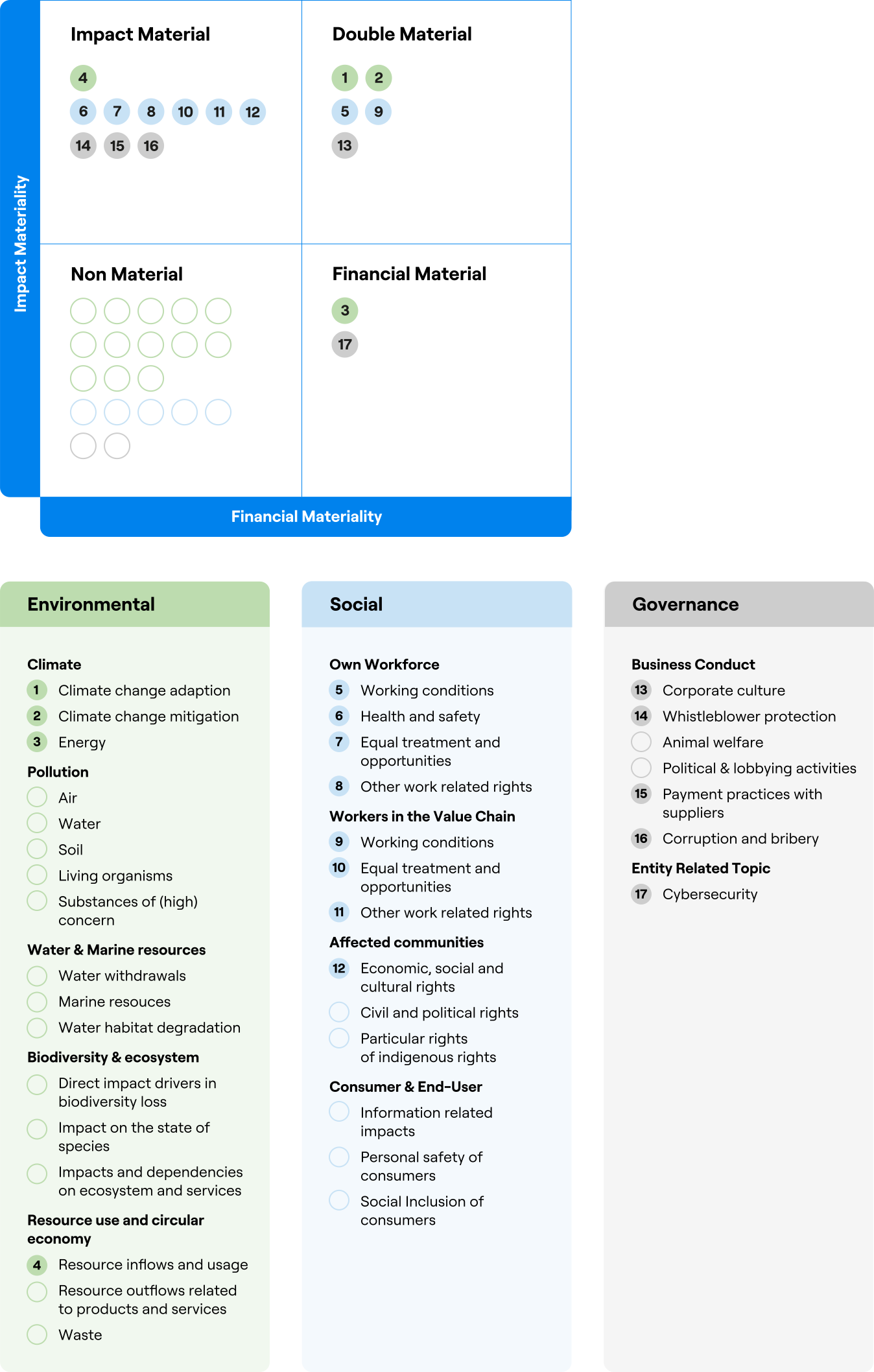
Considering reporting under the ESRS standard in future, Cicor undertook a Double Materiality Assessment (DMA) in 2024. The DMA was reviewed and updated in 2025 based on new risk and opportunity considerations. By applying this dual perspective, Cicor ensures that stakeholder expectations relating to sustainability impacts, opportunities, and risks are addressed. The analysis serves as the foundation for strategic decision-making and the Company’s commitment to long-term value creation. The materiality scoring method and criteria focus on:
- Impact materiality: Considering the scale, scope, irremediability, and likelihood of impacts being positive/negative and actual/potential. Severity takes precedence over likelihood for potential negative human-related rights impacts.
- Financial materiality: Assessing financial significance of risks/opportunities by assessing their likelihood and the nature of financial impacts.
The legal definition of materiality was taken into account throughout the process. The results of this analysis and the material topics were confirmed by the Cicor Management Board in this reporting year. Cicor is committed to regularly revisiting the DMA in order to identify, assess, and prioritise impacts, risks and opportunities (IRO’s), while taking into account evolving trends, underlying assumptions, context, and regulatory changes. As part of the Cicor Risk Management System, the DMA was digitised further for the Sustainability Report 2025 to ensure efficiency and accuracy in future revisions. The 2025 report describes these topics in accordance with the GRI Sustainability Reporting Standards and the TCFD. KPMG has provided independent limited assurance on selected sustainability information. The assurance report is published at the end of this report and contains further information. Each indicator that was subject to limited assurance is marked with a blue checkmark.
1.3Double Materiality Analysis
GRI 3-2: List of material topics
1.4Report Structure
This report provides disclosures organised as follows:
DMA category | Chapter | KPMG assured |
Environmental | ||
Climate | Scope 1 and 2 (as per GRI 305-1 / GRI 305-2) Energy consumption (as per GRI 302-1) Waste generated (as per GRI 306-3) | |
Climate change adaption | ||
Climate change mitigation | ||
Energy | ||
Resource use and circular economy | ||
Resource inflows and usage | ||
Social | ||
Own Workforce | Employees (as per GRI 2-7) Diversity of governance bodies and employees (as per GRI 405-1) | |
Working conditions | ||
Health and safety | ||
Equal treatment and opportunities | ||
Other work-related rights | ||
Workers in the Value Chain | ||
Working conditions | ||
Equal treatment and opportunities | ||
Other work-related rights | ||
Affected Communities | ||
Economic, social and cultural rights | ||
Governance | ||
Business Conduct | ||
Corporate culture | ||
Whistleblower protection | ||
Payment practices with suppliers | ||
Corruption and bribery | ||
Entity Related Topic | ||
Cybersecurity | ||
1.5Stakeholder Engagement
GRI 2-29: Approach to stakeholder engagement
GRI 3-1: Process to determine material topics
GRI 3-2: List of material topics
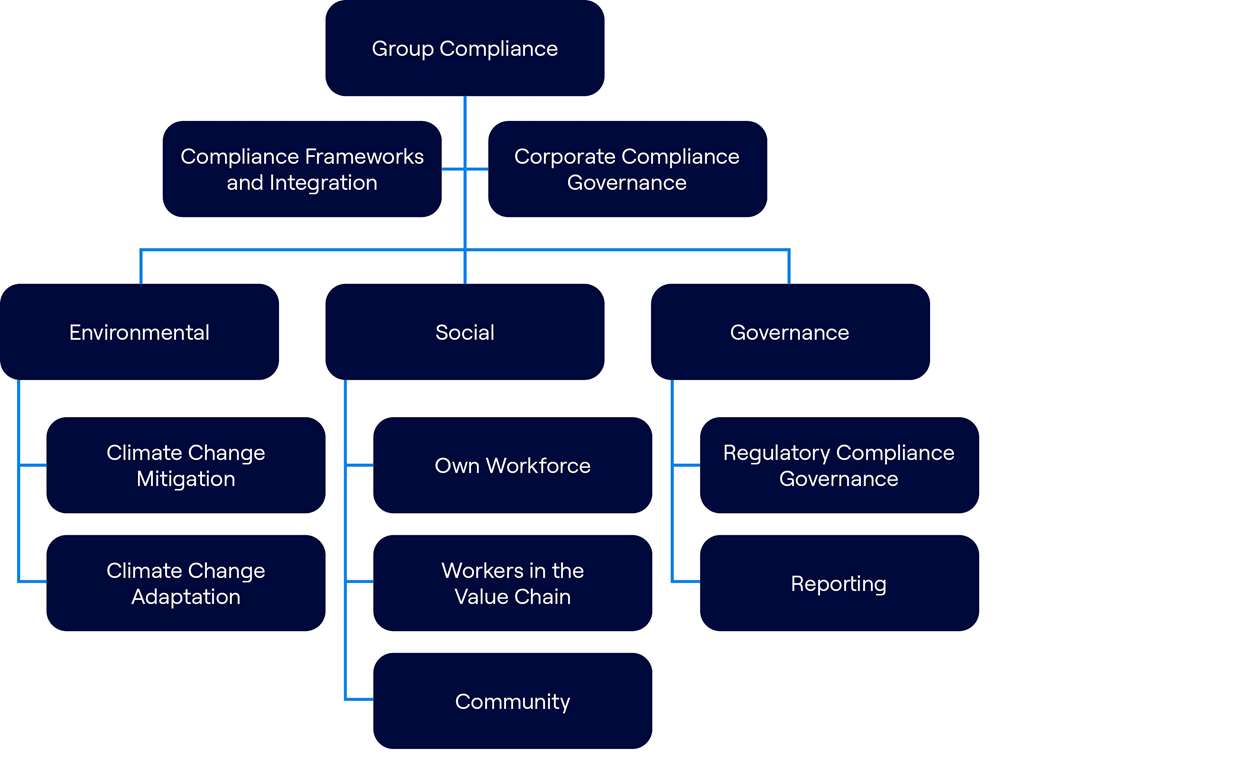
As a key component of the Company’s DMA, Cicor implemented an internal stakeholder engagement process to identify employees with strong knowledge of the affected stakeholders. Users of sustainability statements were appointed to act as stakeholder representatives. Their role was to address stakeholders’ expectations on sustainability matters, as well as identifying and scoring impacts. For the revision of the DMA, the scope of stakeholder engagement has been extended and plays a vital role of the Cicor compliance structure, with named Sustainability Champions in each defined stakeholder section. These champions are led by group-wide leaders for each workstream, as detailed in the Compliance Organisation chart below. The leaders include the Group Compliance Officer, VP Sales, VP Human Resources, VP Strategic Sourcing, and VP IT.
Based on the DMA analysis and as part of the Cicor compliance initiatives, double materiality has been integrated into the Cicor compliance structure, as detailed below:
As part of the process, the analysis also considered whether any risks or opportunities could derive from financial effects of any identified impacts or dependencies. The stakeholder groups were defined in the following categories:
Stakeholder | Definition |
Employees | People are the heart of the Company’s business. Cicor is committed to providing a safe, engaging and meaningful workplace for the Company’s employees where collaboration can thrive. |
Customers | As a company, Cicor focuses on customers’ needs. Engaging with its customers on a continuous basis to understand their perspectives and needs is an embedded part of the Company’s business model. |
Shareholders | Cicor is listed on the Swiss Stock Exchange and engages with its shareholders on a regular basis to ensure efficient financial allocation and to understand the shareholders’ interests. This is done by the Company’s Investor Relations department, management participation in investor roadshows and on conference calls, at briefings with analysts and at the Annual General Meeting. |
Suppliers | The company engages in dialogue with its suppliers, focusing on developing long-term partnerships to achieve a reliable, responsible and sustainable supply chain aligned with the Company’s goals. |
Communities | The company aims to support local communities wherever Cicor has operations. Responsible business practices and engaging in dialogue are linked to the Cicor core values. |
1.6Anchoring Sustainability Across the Corporate Governance Structure
TCFD: Governance
GRI 2-14: Role of the highest governance body in sustainability reporting
GRI 2-16: Communication of critical concerns
GRI 2-17: Collective knowledge of the highest governance body
Cicor aims to promote a strong framework on environmental, social, and governance topics. In collaboration with its business partners, the Company is committed in supporting a sustainable future. Sustainability is anchored across Cicor’s corporate governance structure and is cascaded throughout the organisation. Cicor Group Compliance monitors environmental, social, and governance topics closely, including regular risk assessments, establishment of internal controls and documentation of data.
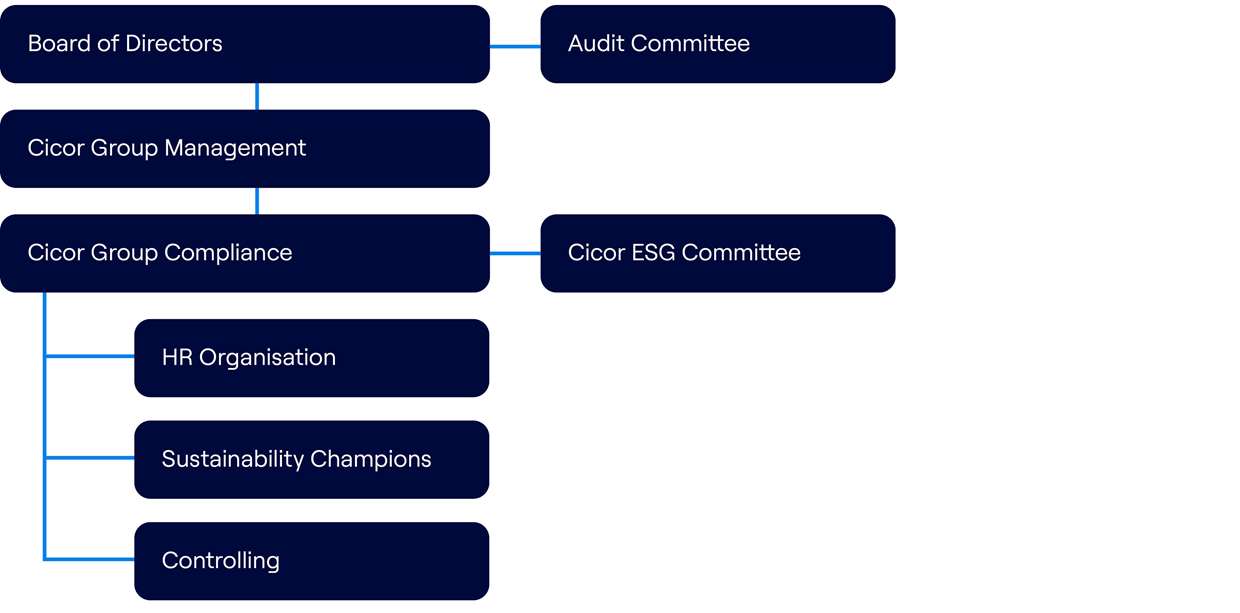
Body | Key Responsibilities |
Board of Directors | Oversees environmental, social and governance performance. The BoD is regularly updated on progress and evaluates together with the Group Management future progress and goals. |
Audit Committee | Amongst other things, responsible for overseeing financial and non-financial reporting as well as external audits, internal controls and risk management relating to environmental, social and governance topics. It also receives notification of results of whistleblower investigations. |
Cicor Group Management | Oversees compliance of the environmental, social and governance guidelines and updates the BoD and the Audit Committee on performance on progress along the organisation according to the Cicor Group Compliance reports. |
Cicor Group Compliance | Defines initiatives to achieve environmental, social and governance goals and oversees progress. Evaluates and monitors new legal requirements on key initiatives to ensure compliance with stakeholder expectations and executes on strategic targets as well as risks and controls across the organisation. Driven in close liaison with regional management, work and reporting are supported by appointed leaders within the organisation. Cicor Group Compliance reports to the Cicor Group Management. |
Cicor ESG Committee | The Cicor ESG committee identifies as a group of leaders within the organisation exchanging knowledge and expectations across the Cicor structure, as well as upcoming challenges on environmental, social and governance topics. |
HR Organisation | The HR Organisation is responsible for social matters within the organisation, aligning with Group Compliance on important topics such as diversity, inclusion and health and safety. |
Sustainability Champions | Locally defined sustainability champions support Cicor Group Compliance in evaluating data for the Cicor environmental journey and support the environmental initiatives. |
Controlling | Group-wide ESG Controlling supports Group Compliance by reviewing, validating, and monitoring ESG key performance indicators (KPIs) and underlying data points to ensure accuracy, consistency, and reliability. |
Cicor prioritises sustainability at every level of the organisation. As part of the Cicor 2028 ‘Creating Together’ strategy, sustainability has become an even more integral focus for the Board of Directors. Progress towards sustainability goals is regularly reviewed by both the Board of Directors and senior management. Furthermore, Cicor’s due diligence for non-financial matters encompasses a broad spectrum of social and governance aspects. All of these are subject to approval by the Board of Directors.
The Board of Directors remains available to address stakeholder and shareholder concerns. Any issues raised during the Annual General Meeting are managed in accordance with the Articles of Association. In 2025, no significant concerns were brought directly to the attention of the Board of Directors outside of the Annual General Meeting. Further details on governance arrangements can be found in the Corporate Governance Report.
Sustainability reporting is subject to the risk of misstatement due to human error or incomplete data. To manage these risks, Cicor has implemented several processes. In 2024, the Company strengthened its reporting system and further improved its approaches, methodologies, and data points as part of the 2025 reporting process. Cicor views sustainability as an ongoing improvement journey. Reporting that is aligned across ESG topics enables Cicor to share accurate data on its emissions, social, and governance indicators. Measuring the impact on all aspects of ESG risks has become increasingly important and has been identified as a strategic differentiator for the future. ESG factors into compliance systems ensures the stability and efficient tracking of risks across all Cicor sites.
Each aspect of ESG reporting is closely monitored by Cicor Group Compliance. The following aspects are covered in each workstream:
Environmental
- Environmental Management System and aligned emission reporting compliant with the Cicor Environmental Reporting Guideline.
- Management of materials of concerns in its own operations and in the supply chain aligned with the Cicor Substances and Materials of Concerns Guideline.
Social
- Human Rights and child labour practices aligned with ILO (International Labour Organization) Standard practices for own workforce aligned with the Social Responsibility Guideline and reporting framework.
- Responsible supply chain approaches and processes including risk management for suppliers aligned with the Cicor Responsible Sourcing Guideline and Customer Due Diligence Guideline.
Governance
- Alignment with Cicor core values and standards aligned through the Employee Code of Conduct and the Business Partner Code of Conduct for internal and external stakeholders.
- Implementation of adequate risk management and business continuity planning and processes aligned with the Cicor Risk Management and Business continuity Guideline.
All Cicor sites undergo regular ESG scoring to identify any gaps or misalignments at an early stage. By evaluating an improvement pathway with each company, the Company can further strengthen the framework and ensure compliance with regulations and stakeholder needs. The ESG scorecard is integrated into Cicor’s Compliance Management System, enabling annual reviews at entity level aligned with Cicor’s key performance indicators.
The ESG Scorecard approach also supports the post-merger integration (PMI) journey for new companies joining the Cicor Group, providing a shared baseline framework to ensure the companies are aligned and integrated quickly and adequately within a 6-month timeline. It also helps companies adapt to sustainability reporting as part of their first full reporting year.